
Performance estimate method (Riegel)
In Plain English
Sometimes you will log a run that is a different distance from your goal distance or your usual benchmark. When that happens, optimal may estimate an equivalent performance using a well-known running model called the Riegel method.
This helps answer a practical question:
- If I ran farther today, was the run still strong enough to count against my goal?
Why optimal uses it
The goal system needs a fair way to compare runs of different lengths. Running 10 km is not the same as running 5 km, even if the effort feels similar. The Riegel method gives a simple way to estimate how performance usually changes as distance increases.
Important: This is an estimate, not a perfect prediction. People vary a lot in endurance. Treat it as a practical rule of thumb, not an absolute verdict.
A simple example
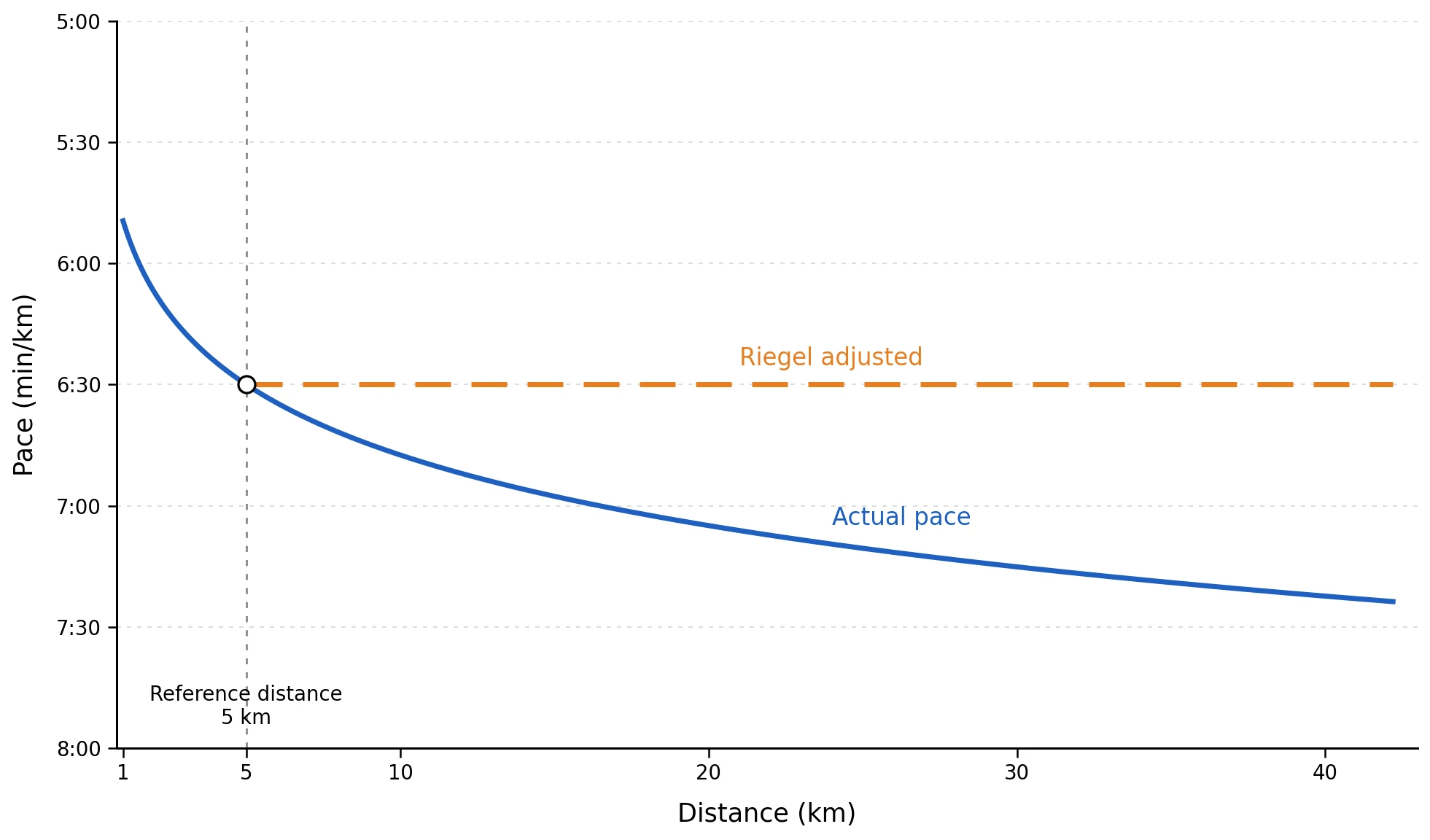
Let’s say your goal is based on a strong 5 km pace, but today you logged a longer run.
- You have a running performance goal based on a reference pace
- You log a longer run with a real pace
- optimal estimates what pace would be roughly equivalent at that longer distance
- If your logged pace is as fast as, or faster than, that equivalent pace, the goal can be marked as achieved
This is useful for people who sometimes train longer but still want shorter-distance performance goals to stay meaningful.
When it applies in optimal
At the moment, the Riegel adjustment is used for running performance goals when a newly logged run is being checked.
In general, the adjustment only applies when the logged run is longer than the reference distance used for comparison. That helps avoid over-correcting shorter runs.
More detail (optional)
If you are interested in how it works, the basic idea is simple: as distance increases, equivalent time increases slightly more than linearly.
Show the formula
The Riegel model is commonly written as:
T2 = T1 × (D2 / D1)1.06
- T1 = time at distance D1
- T2 = estimated equivalent time at distance D2
- The exponent (1.06) is a commonly used default for recreational runners
In optimal, the same idea is applied in pace terms when checking whether a logged run is equivalent to a running goal.
Reference
If you would like more background:
Part of the optimal health library
Understand your running performance
Create an account to start tracking your performance.
Create an account to start tracking your performance