You Don’t Need a Gym
How to build a stronger, fitter body without memberships, machines, or mirrors
For some people, the gym works well. It offers structure, equipment, and a dedicated place to exercise. But for plenty of others, it becomes a barrier rather than a solution. It may be too expensive, too awkward, too crowded, too far away, or simply not a place they want to be.
If that’s you, there’s good news. You do not need a gym to improve your health, build strength, or increase your fitness. Most of what you need is already available to you: your body, a bit of space, and a willingness to begin. The rest is consistency.
The Cost of Waiting
A gym membership can be useful, but it is not a prerequisite for progress. Many people delay getting started because they assume fitness only counts if it happens in a gym. That belief costs them months or years of momentum.
What if your progress can begin exactly where you are, with what you already have?
The truth is that fitness improves when you move regularly and challenge your body in practical ways. That can happen in your living room, in your backyard, on a footpath, at a park, or on the floor beside your bed.
What Fitness Actually Requires
You do not need a room full of machines. At its core, fitness comes down to a few simple ideas:
- A way to move often
- A way to challenge your body
- A way to recover and repeat
For most people, general fitness comes down to improving three areas:
- Cardio endurance — your heart, lungs, and stamina
- Strength — your muscles, bones, and physical capacity
- Mobility — your joints, balance, posture, and ease of movement
None of these requires a gym. In many cases, gym-free training is easier to stick with because it fits into normal life and teaches your body to move well in real-world conditions.
The Home Advantage
Working out at home or outdoors has some genuine advantages. It removes travel time, lowers cost, reduces friction, and makes it easier to build exercise into the rhythm of an ordinary week.
You may only need:
- A little space to stand, stretch, or lie down
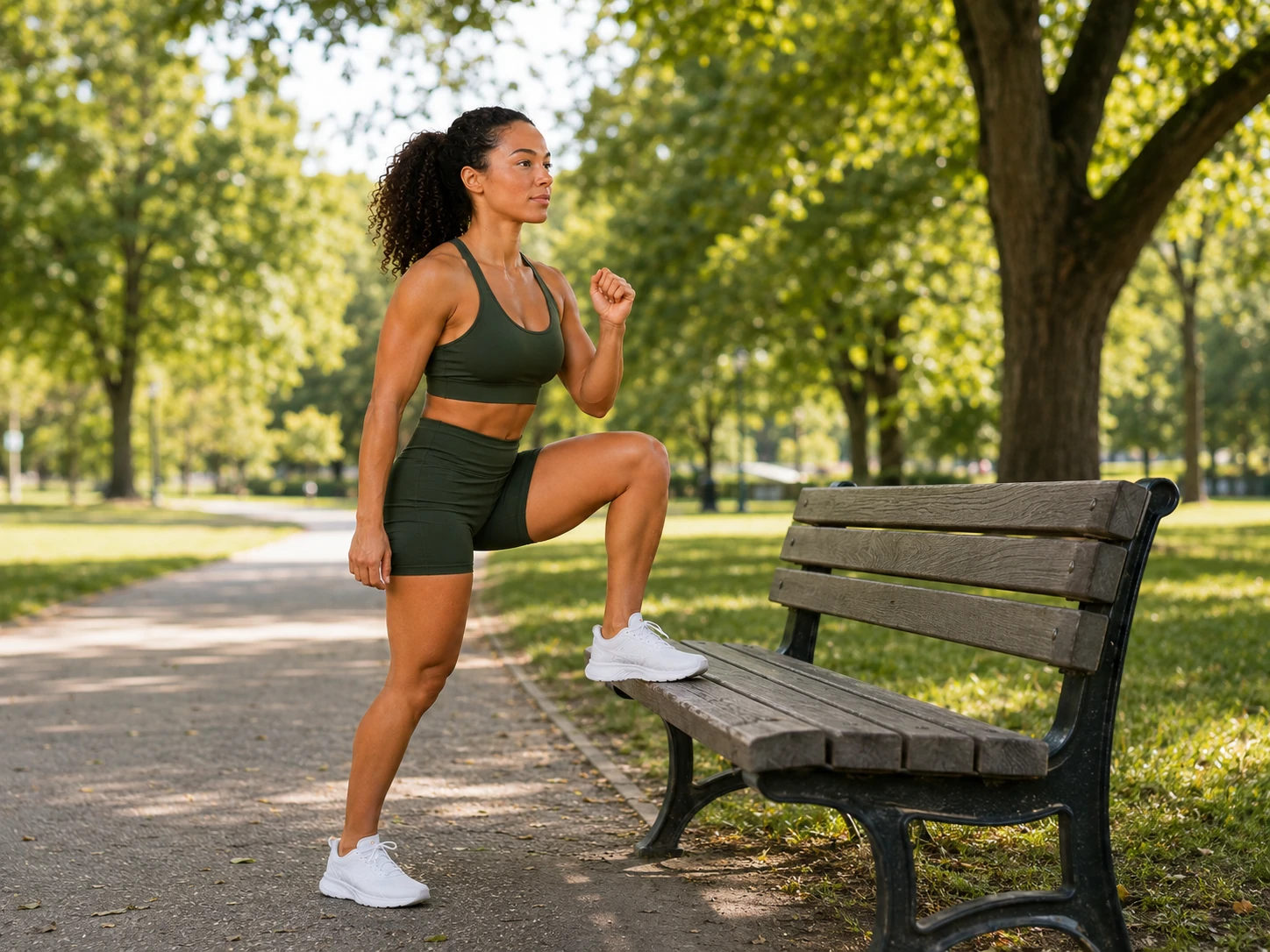
- Your own bodyweight for movements like squats, push-ups, planks, bridges, and step-ups
- A few optional low-cost tools such as a resistance band, skipping rope, or a backpack loaded with books
That is enough to start building a stronger body.
What Counts as Exercise?
Exercise does not have to look impressive to work. A brisk walk counts. A short workout counts. Climbing stairs counts. Ten minutes of deliberate movement absolutely counts.
People often underestimate simple, repeatable activity because it does not look dramatic. But fitness is not built by dramatic moments. It is built by repetition.
Movement is cumulative. Small sessions done consistently will outperform grand plans you never begin.
A Simple Beginner Pattern
If you are starting from scratch, a basic week might look like this:
- Monday — Brisk walk for 15 to 20 minutes, then 2 rounds of push-ups, air squats, and a plank
- Wednesday — Another brisk walk, followed by balance and mobility work such as ankle rolls, hip stretches, or standing on one foot
- Friday — Repeat the Monday session, or add one new movement such as glute bridges, step-ups, or a short jog
That may not sound like much, but it is enough to create momentum. Once momentum exists, fitness becomes easier to build.
What Gyms Offer — and What They Don’t
Gyms do offer useful things: variety, heavier equipment, classes, and a separate place devoted to exercise. For some people, that structure is exactly what they need.
But a gym does not guarantee consistency, and it does not remove the need for effort. If your gym is inconvenient, intimidating, or mismatched to your life, it can become one more reason not to train.
You are allowed to build fitness in a way that suits your actual life, not an imagined ideal version of it.
Real fitness does not depend on swipe cards or mirrored walls. It depends on honest effort, repeated over time.
Start With What You Can Do
You do not need to wait until you feel confident. You do not need perfect gear, a perfect body, or a perfect routine. You need a starting point that is realistic enough to repeat.
That might mean walking three times a week. It might mean ten minutes of yoga. It might mean stretching while dinner is in the oven. The exact format matters less than the fact that it happens.
The best kind of exercise is the kind you'll still be doing next month.
Final Thought
You don't have to become anti-gym. And you don't have to prove anything by doing it all with no equipment. But if you have been waiting to begin because the gym was never quite right for you, stop waiting.
Start where you are. Use what you have. Build from there.
Fitness is not something you buy. It is something you build, in your body, with your own time, effort, and repetition.
Part of the optimal health library
Build your personalised training plan
Create a free account to build your personalised training plan.
Create a free account to build your personalised training plan