
How to Measure Your Resting Heart Rate
To measure your resting heart rate, check your pulse first thing in the morning while your body is fully at rest. You can do this manually at your wrist or neck, or use a smartwatch or fitness tracker if you prefer an automatic reading.
Your resting heart rate (RHR) is one of the simplest health metrics to track, and one of the most useful. It takes less than a minute to measure, and over time it can help you understand your fitness, recovery, stress, and overall health more clearly.
What is resting heart rate?
Your resting heart rate (RHR) is the number of times your heart beats per minute while your body is fully at rest.
In general, a lower RHR can suggest that your heart is working efficiently. A higher reading can reflect stress, poor sleep, illness, dehydration, or a heavier training load.
What matters most is not one isolated number. It is the pattern over time.
When to measure resting heart rate
The best time is first thing in the morning, just after waking.
- Before coffee
- Before screens
- Before work or other stress
If possible, measure it under similar conditions each time. Consistency makes the result more useful.
How to measure your resting heart rate
There are two simple ways to measure resting heart rate accurately.
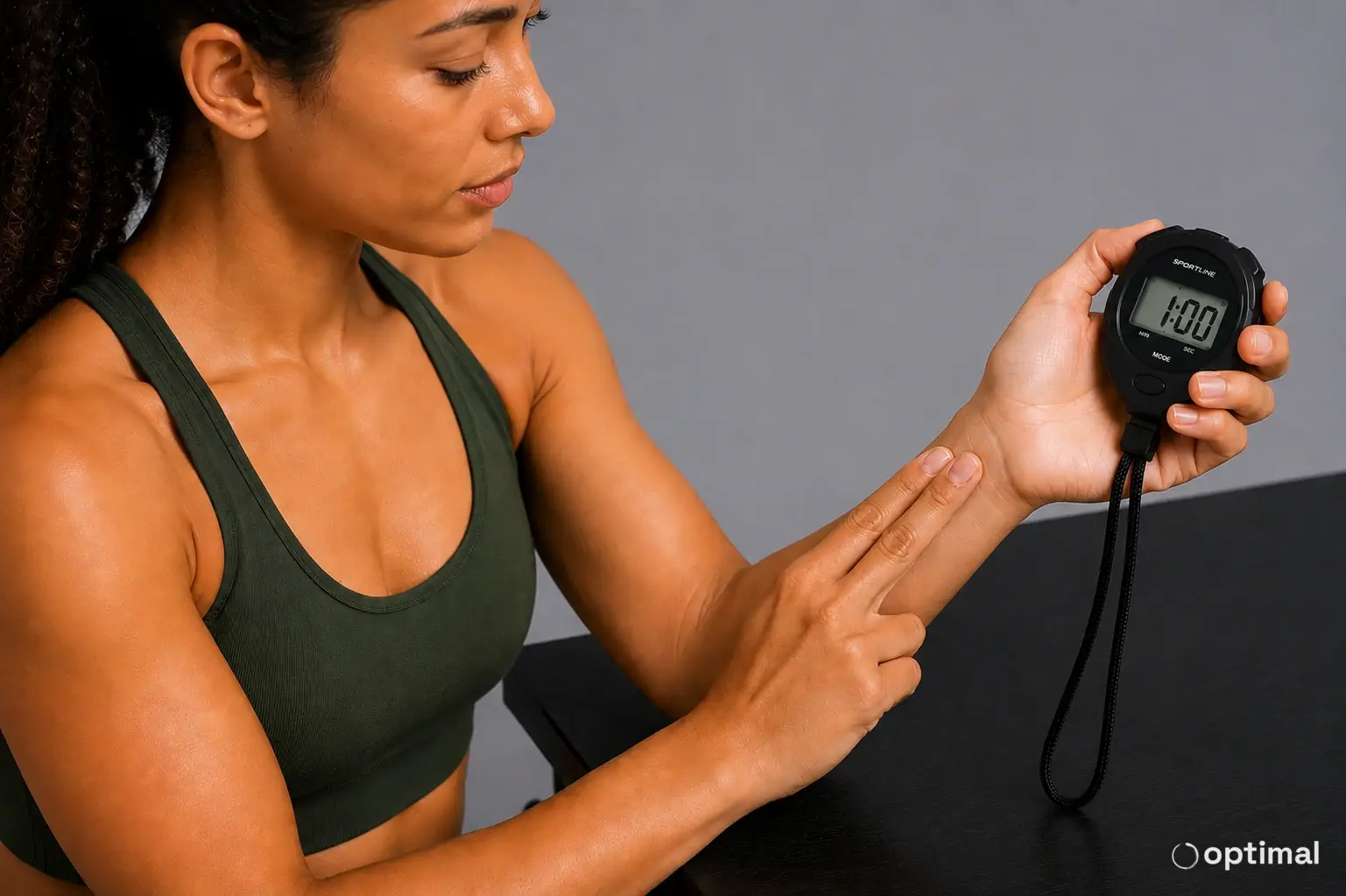
Measure it manually
- Sit or lie still for a few minutes
- Find your pulse at your wrist or neck
- Count the beats for 60 seconds using a timer
You can count for 30 seconds and multiply by 2, but a full minute is more accurate.
Use a device
- Most smartwatches and fitness trackers measure resting heart rate automatically
- Garmin, Apple, Oura, Whoop, and others record daily readings
- Some phone apps can estimate pulse using your camera and flash
Whichever method you use, stick with it. Using the same method makes your trend easier to interpret.
What’s a normal resting heart rate?
For most adults, a typical resting heart rate falls between:
- 60–100 bpm
Well-trained athletes may sit between 40–60 bpm.
But context matters. Your usual reading can be affected by:
- Sleep
- Stress
- Illness
- Medications
- Training load
- Hydration
This is why trends are more useful than a one-off reading.
Tips for accurate readings
- Measure at the same time each day
- Avoid caffeine or alcohol beforehand
- Sit or lie still for 3–5 minutes first
- Do not talk or move during the reading
- If you are unwell, stressed, or slept badly, make a note of it
A single reading can be interesting. A trend over weeks is useful.
What should you do with this information?
Log it and watch the pattern.
You do not need to react to every small change. But if your resting heart rate starts drifting upward, that can be a sign to look at sleep, stress, illness, hydration, or recovery.
Adding short health notes alongside your readings can make it much easier to understand why the number changed.
Final Thought
Resting heart rate is not a score. It is a signal.
Used well, it can help you understand how your body is coping, recovering, and changing over time. That makes it one of the simplest and most valuable metrics to track.
Part of the optimal health library
Start tracking your health metrics
Create a free account to start tracking your health metrics.
Create a free account to start tracking your health metrics