
Seated Resistance Band Row
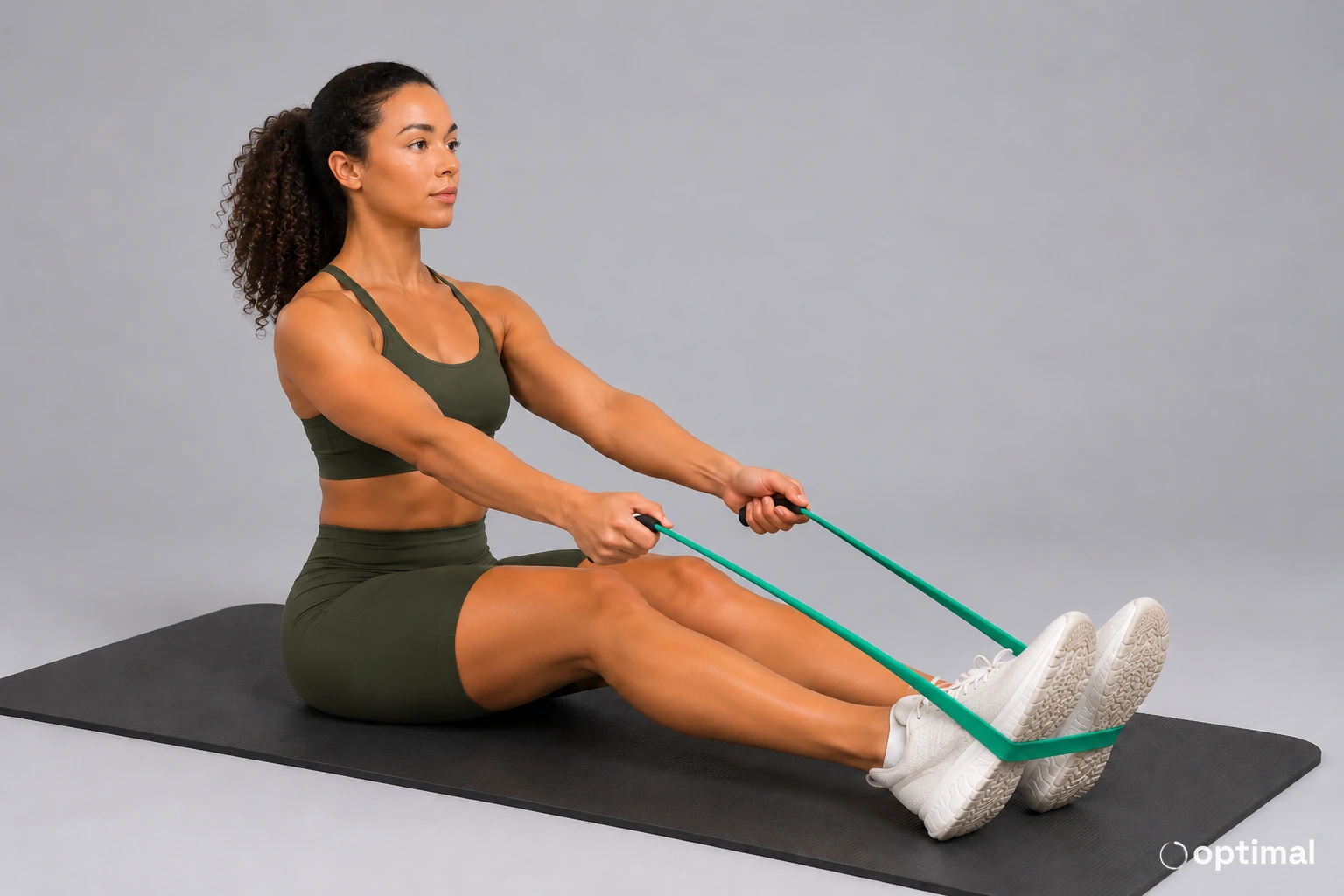
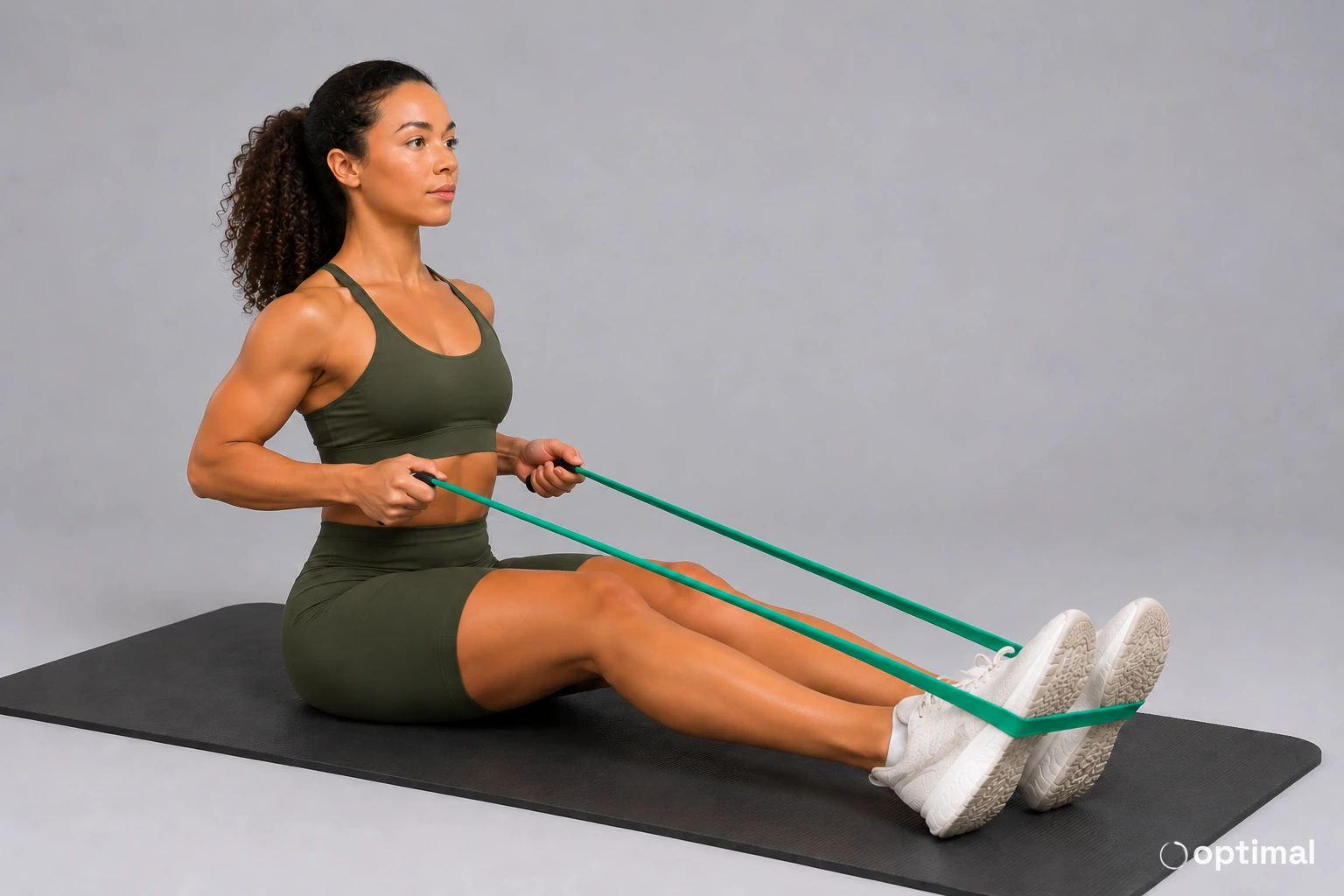
The seated resistance band row is a simple upper-back strengthening exercise you can do on the floor without a fixed anchor point. Unlike the standing row, which uses a band anchored in front of you, this variation loops the band securely around both feet while you sit upright and pull towards your ribs.
Equipment Needed
- A long resistance band suitable for rowing, with enough length to hold one end securely in each hand
- An exercise mat or comfortable, non-slip floor surface
Muscle Groups Targeted
- Rhomboids and middle trapezius, which help draw your shoulder blades together
- Latissimus dorsi (lats) and rear deltoids
- Biceps and forearms, which assist the pull and grip
- Core and postural muscles, which help maintain an upright torso
How to Do a Seated Resistance Band Row
- Sit on the floor with your legs extended forward and your knees slightly bent. Sit tall with a comfortable, neutral spine.
- Loop the middle of the band securely around the soles of both feet, towards the midfoot rather than loosely over your toes. Check that it cannot slip off under tension.
- Hold one end of the band in each hand with a secure grip. Extend your arms forward until there is gentle tension, keeping your shoulders relaxed.
- Keeping your torso upright and steady, draw your elbows backwards close to your ribs until your hands approach your lower ribs.
- Gently draw your shoulder blades together without shrugging or thrusting your chest forward.
- Slowly extend your arms back to the starting position. Keep control of the band throughout the return.
- Repeat for your chosen number of repetitions without rocking backwards to add momentum.
Posture and Technique Tips
- Sit tall: keep your spine neutral rather than rounding your lower back. Slightly bend your knees if that helps you sit upright.
- Keep your torso still: your arms and shoulder blades should do the rowing, not a backward lean.
- Keep elbows close: pull back alongside your ribs rather than flaring your elbows wide.
- Control both directions: pull smoothly and resist the band as your arms extend.
- Relax your neck: avoid shrugging your shoulders towards your ears.
Common Mistakes and Safety
- Band slipping off the feet: place it around the soles towards the midfoot, not across the tips of your shoes or toes; make sure it stays secure before each set.
- Leaning backwards: reduce resistance if you have to rock your torso to finish a repetition.
- Rounding your back: bend your knees a little more or sit on a stable folded towel if needed to maintain a comfortable upright position.
- Band snapping back: check for wear or tears before use, keep your grip secure, and avoid the possible recoil path. Keep the pull away from your face.
- Pain or discomfort: stop if you experience sharp pain in your back, shoulders or elbows. See our guide to training around injury.
Variations and Related Exercises
- Lighter or heavier band: adjust resistance while keeping the same stable rowing technique.
- Single-arm variation: row one arm at a time if your band setup allows you to keep the other side securely controlled.
- Standing row: a related resistance-band pull performed standing with a fixed anchor.
- Bent over row: a free-weight alternative performed in a hip-hinge position.
For a good seated band row, focus on a stable upright posture, elbows travelling close to your body, and a controlled return—not on how far you can pull the band.
When to Use This Exercise
The seated resistance band row fits naturally into a home-based strength routine, especially when you want an upper-back exercise without a door or wall anchor. It can complement pushing exercises such as the band chest press and other full-body resistance-band movements.
Start with a resistance level that lets you complete each repetition with steady posture and full control.
Part of the optimal health library
Add this exercise to your training plan
Create a free account to use this exercise in your training plan.
Create a free account to use this exercise